
The 80/20 Trap: What the Pareto Rule Does to a System
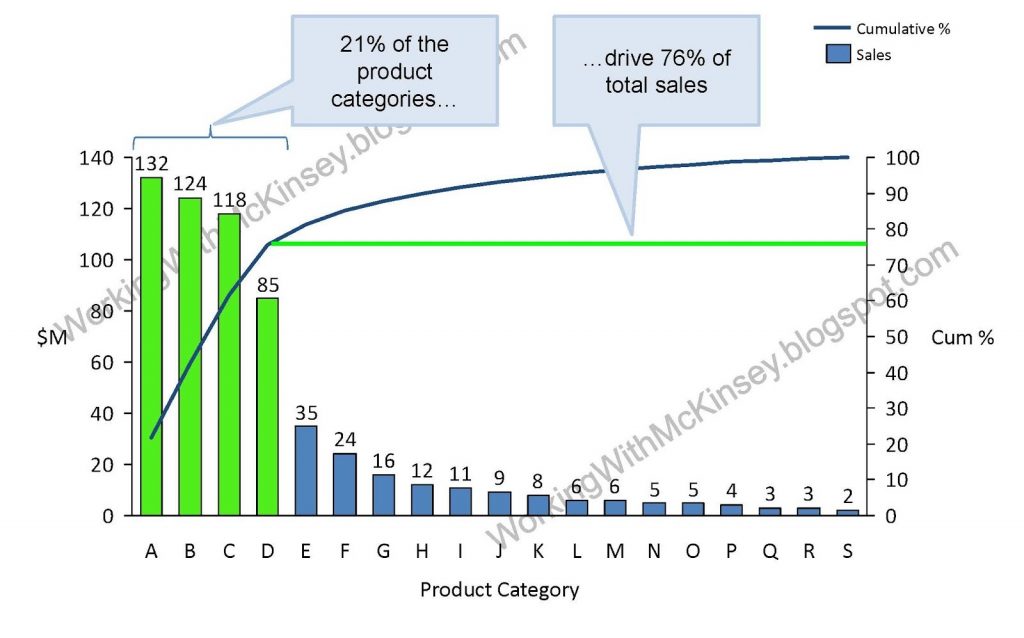
The 80/20 Trap: What the Pareto Rule Does to a System When You Optimise By It
The Pareto principle, 80% of outcomes from 20% of inputs, is one of the most widely applied heuristics in business, and one of the most quietly hazardous.
Not because the people using it are careless, and not because the observation is worthless, but because of what the rule does to a system when it’s used as a decision rule rather than a description.
The failure is structural, and it catches the sharp analyst as reliably as the lazy one,
which is exactly why “just think more critically about it” isn’t the fix.
Start with what the rule actually is. Pareto’s original observation was about land ownership in Italy, a specific empirical pattern in one dataset.
It has since hardened into a universal law applied to sales, talent, time, and product, on the assumption that the 80/20 ratio is somehow built into reality.
It isn’t.
It’s a distribution that shows up sometimes and often doesn’t, and treating it as a constant means applying a ratio to data that frequently don’t support it.
But the deeper problem isn’t the imprecision of the ratio. It’s what happens when you take the rule seriously as an instruction, concentrate on the vital few, cut the trivial many, and let it drive decisions.
The recursive collapse
Here is the structural trap almost no one applying the rule sees coming, and it’s the most important thing about it. The 80/20 rule, applied as an optimisation, doesn’t run once. It runs again on its own output.
Cut the “trivial” 80% and keep the “vital” 20%. Now look at what remains, and a new 80/20 distribution appears within it, because that’s how distributions work: the surviving 20% has its own vital few and trivial many.
So the rule, applied consistently, tells you to cut again. And within that remainder, another 80/20. Each cut is locally rational; you’re always trimming the least productive portion. and the sequence has no natural stopping point. Follow it to its conclusion, and you optimise your way down to one product, one customer, one employee, having destroyed at every step the base that made the top possible.
This isn’t hypothetical. It’s roughly the logic that hollowed out British Rail: prune the least-used lines as inefficient, and the network that fed passengers into the profitable core shrinks, so those routes become less used, so the next 80/20 cut removes them, and the system optimises itself toward collapse one locally sensible cut at a time.
The rule never says stop, because at every stage there’s always a trivial many to cut. That’s the hazard: not that 80/20 gives wrong answers, but that, applied recursively, it gives a sequence of locally correct answers that sum to systemic destruction. A rule that’s rational at each step and catastrophic in aggregate is not a thinking error.
It’s a structural property of the rule.
Why the “trivial many” isn’t trivial
The recursive trap has a quieter cousin. The rule instructs you to ignore the trivial many, but “trivial” is defined only by current contribution, and current contribution is a lagging measure. The long tail an 80/20 cut discards, is where emergent trends, small-but-growing segments, and early signals of the next shift actually live.
Optimise hard for the vital few, and you’re optimising for yesterday’s distribution, systematically blinding yourself to tomorrow’s because the thing that will matter next always starts in the tail that the rule tells you to cut. This is why aggressive 80/20 optimisation so often precedes a company being surprised by a competitor who grew up in a segment it had rationally discarded.
Applying it to people repeats a mistake we’ve made before
The most damaging application is to people: the belief that 20% of employees produce 80% of results, so identify and over-reward that 20%.
This fails for a reason that has nothing to do with fairness and everything to do with causation; it misattributes a system-produced output to individuals.
Performance is largely produced by the architecture people work inside: the person who appears in the “vital 20%” is often the one standing at a favourable structural position, and the one in the “trivial many” is frequently a capable person, the structure has poorly deployed. Rank and reward on the 80/20 split, and you’re doing exactly what forced ranking does, reading a structural output as an individual trait, then rewarding position while calling it merit.
And because performance is interdependent, the “trivial” 80% frequently includes the people whose work makes the visible 20%’s results possible; cut or demoralise them and the vital few stop being vital.
You’ve optimised the measurement and destroyed the thing it was measuring.
Where the rule is actually useful
None of this makes the principle completely worthless, and the point isn’t to think harder; it’s to understand what the tool does.
As a lens, 80/20 is genuinely useful: “Where are the disproportionate leverage points here?” is a good question, and noticing that effort and outcome are often unevenly distributed is a real insight.
The rule works as a prompt for attention: A way of asking where concentration might exist.
It fails the moment it stops being a question and becomes a decision rule – the moment “where’s the leverage?” hardens into “cut the bottom 80%.”
The distinction is between using it to see a distribution and using it to act on one recursively. The first is a lens; the second is the structural trap.
Knowing which one you’re doing is the entire skill, and it’s not a matter of intelligence; plenty of very capable people apply the rule as a decision rule and walk straight into the recursion, because the rule’s danger is in its mechanics, not in the user’s mind.
The point
The Pareto principle isn’t lazy thinking, and its users aren’t fools.
It’s a distribution-observation that becomes hazardous the moment it’s promoted from a lens to a rule because, as a rule, it recurses toward collapse, it optimises for yesterday’s distribution, and applied to people it misreads structural outcomes as individual worth. Use it to ask where leverage concentrates: good question.
Use it to decide what to cut, again and again: structural liability.
The skill isn’t thinking harder about the ratio.
It’s knowing that a rule which is locally rational at every step can still be globally ruinous and that no amount of the rule’s own logic will ever tell you when to stop applying it.