
The System That Needs SWOT
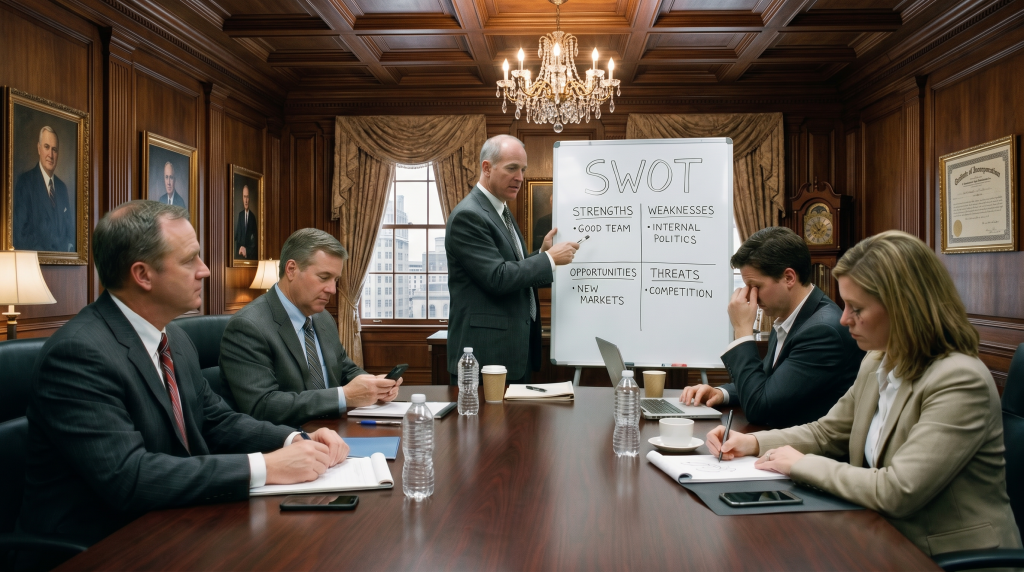
The System That Needs SWOT.
Why managerial tools survive long after their usefulness dies.
Every few years, organisations rediscover their affection for the SWOT analysis. It gets dusted off, formatted onto a slide, and pressed into service as strategy. But SWOT’s persistence has little to do with its usefulness. It survives because it fits, almost perfectly, the needs of systems that find structural honesty difficult.
SWOT is less a tool than a symptom. Many organisations don’t actually want strategy in the demanding sense. They want the experience of strategy – the session, the alignment, the feeling of forward movement – without the disruption that real change requires. SWOT serves that need extremely well.
1. It protects the mythology
Ask a system for its strengths, and it offers its favourite stories. Ask for weaknesses, and it offers its accepted excuses. Opportunities tend toward optimism; threats tend toward politics. This isn’t a failure of the people in the room; it’s what the format invites. The four boxes let leaders discuss the organisation without confronting the architecture that produces its behaviour, or the culture that the architecture expresses.
What SWOT quietly preserves is the gap between the organisation’s story about itself and what it actually rewards.
2. It can’t, by design, reveal the thing it claims to examine
A system is defined by its decision rights, its interfaces, its constraints, its incentives, and how consequence flows through it.
SWOT captures none of these.
It captures what people are comfortable saying in a room, which is the most accessible organisational data, and also the least reliable. A tool that stops at the threshold of comfort can’t diagnose a system, because the system’s real behaviour lives on the other side of that threshold.
3. It builds consensus where it should build inquiry
The moment four boxes go up on a wall, the room begins, understandably, to negotiate what’s acceptable to write in them. Consensus takes the place of inquiry. The group converges on what is already known, already believed, already tolerated. Little that is emergent survives the process, and little that is structural enters it. The result feels like an analysis but functions more like a rehearsal, the organisation performing a view it already holds.
4. It looks backward and projects forward, with nothing in between
Strengths and weaknesses are anchored in the past. Opportunities and threats are anchored in projection. What the format never reaches is the part in between: the forces that make some futures structurally likely and others nearly impossible. It describes where the organisation has been and imagines where it might go, while leaving untouched the architecture that actually connects the two, which is the only part a leader can change.
5. It endures because it asks nothing difficult
This is the heart of it, and it’s worth stating plainly rather than critically. Real strategy touches power. Real diagnosis touches comfort. Real structural work touches the equilibrium an organisation has settled into. SWOT touches none of these, and that is precisely why it lasts. It is safe, it is collegial, and it rarely produces a finding that would require leaders to change their incentives, their decisions, or their own behaviour.
When a system isn’t yet ready for structural inquiry, it reaches for a tool that keeps inquiry light, one that leaves the deeper logic unexamined.
Understood that way, SWOT isn’t really a planning method at all. It’s closer to a reassurance: a way for an organisation to look squarely at itself and see only what it can comfortably afford to see.
And it lasts for a specific reason rather than a general one: the person who would have to act on a structural finding is usually the person who convenes the session and approves the method. A tool that spares the room is chosen by the people it spares most.
6. The hard truth
If the strategic process begins with a SWOT analysis, it has quietly defaulted to the status quo. If it ends there, the organisation has mistaken a worksheet for a strategy.
The real work begins where SWOT stops: in the decision rights, the interfaces, the incentives, and the consequence logic that produce the system’s actual behaviour, and beneath those, in the culture that decided what the organisation would reward in the first place. That is the layer SWOT is built to never reach.
The need isn’t for a better SWOT. It’s for the willingness to look past it.