
Nobody Owns the Clock
Nobody Owns the Clock
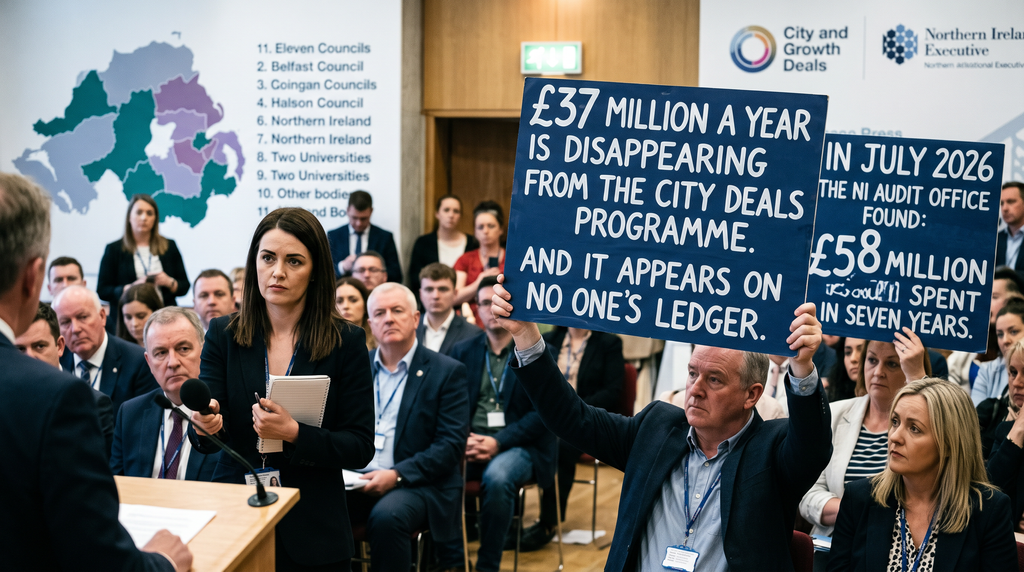
£37 million a year is disappearing from a public investment program, and it appears on no one’s ledger
In July 2026, the Northern Ireland Audit Office published its review of the four City and Growth Deals: a £1.334 billion capital program announced in 2018, funded jointly by the UK Government and the Northern Ireland Executive, delivered through eleven councils, two universities, four further education colleges, a health trust and six government departments.
By March 2025, seven years in, £58 million had been spent. That is 4.4 percent.
The report’s own calculation is the one worth sitting with. At three per cent inflation, the unspent balance of approximately £1.221 billion loses around £37 million of real value for each year of delay – £3.05 million a month, or between £2 million and £18 million per Deal per year.
That is not a projection. It is happening now, monthly, and it will go on happening until the money is spent.
The causes are real, and they are not the finding
The report is fair about why progress has been slow, and any reading of it should be too. The Assembly was suspended from 2017 to 2020 and again from 2022 to 2024; Covid required projects to be reshaped; the UK Government paused funding to some Deals in September 2024; construction inflation has been extraordinary; and major capital projects routinely take more than seven years from outline case to operation.
All true, and some of it nobody’s fault. But none of it explains what struck me most: having identified an enormous and continuing cost, the report also shows, without quite saying so, that the cost sits on nobody’s desk.
The sentence that explains the rest
At paragraph 3.12, the auditors record what Deal Program Board members told them about how delay is experienced across the governance framework:
“While Accountable Departments managing ring-fenced funding may face limited immediate operational consequences, Accountable Bodies and Deal Programme Boards must manage the ongoing impacts of delays.”
Read that slowly, because it is the whole argument.
The departments hold the approvals. The money is ring-fenced, so it does not leave their budgets when nothing moves. Delay costs them, in the report’s phrase, limited immediate operational consequence.
The councils and program boards cannot grant their own approvals. They absorb the slippage, the re-scoping, the funding gaps, the sunk costs. They carry a delay they have no power to end.
So the organisation that can speed things up has no reason to, and the organisation with every reason to has no power.
This is what the structure was built to do
That arrangement is not an accident of the program. Someone designed a structure in which approval authority sits in one place, and the cost of slow approval sits in another. Probably nobody chose it in those terms. It emerged from the entirely reasonable decision that central government should hold the purse and local government should deliver.
But an architecture is an organisation’s real answer to what matters here, made operational. And this one expresses something quite clear.
It says that a wrong approval is a serious matter and a slow one is not. It says that assurance is worth a great deal and delivery speed is worth whatever is left over. Nobody in the program would state either proposition out loud, and everyone in it behaves accordingly, because that is what the structure pays for.
What that produces, in numbers
Departments said they may need up to six months to review an Outline Business Case. At Derry City and Strabane, actual average approval time across five projects was 11.8 months.
Board members told the auditors that the duration of the OBC stage was largely driven by the volume and nature of clearance queries raised by departments, and that these delays “affected delivery timelines, eroded project value through inflation and, in some cases, affected viability.” Some described the scrutiny applied to submissions prepared by experienced staff as, in places, overly cautious.
That phrase is worth pausing on. Caution is not a character flaw here. It is the correct response to the position. An official who approves quickly and is later found to have waved something through carries that personally. An official who takes eleven months and asks another round of clearance queries carries nothing at all — the delay cost is real, substantial and entirely somebody else’s.
The test is whether the behaviour would survive a change of people. Move those officials into the councils and give the council officers the approval authority, and the pattern would not reverse. It would reproduce itself with the names exchanged. Whoever holds the approval is insulated from the delay, and whoever is insulated from the delay asks another question.
The risk nobody had written down
The program’s funding has a clock on it. Central government allocations are fixed in value and tied to a fifteen-year timeframe from Deal signing: 2036 for Belfast, 2039 for Derry City and Strabane, 2041 for Causeway Coast and Glens.
If delivery does not accelerate, that funding is at risk. It is the single largest strategic risk in a £1.3 billion program.
The auditors “found no evidence that the risk of future loss of funding resulting from delays has been recognised or addressed within Deal Risk Registers.” When they asked the Department of Finance how it was managing the risk, the answer was that it will propose to the Delivery Board that it be added to the central risk document, reviewed annually, next due in summer 2026.
Eight years into the program, nothing had been registered for the one thing that could lose the money.
Not because anyone thought the deadline unimportant. But because a risk register is populated by people recording risks they own, and the fifteen-year clock belongs to four Deals, eleven councils, six departments, two governments and fifty-odd projects. Which is to say it belongs to nobody, and the thing nobody owns, nobody writes down.
Where the assurance stops
The same pattern appears a third time, and this one is the most telling because the remedy already exists on paper.
Value for money is assessed at outline and full business case stages. After that, the auditors “did not find evidence of systematic VfM reassessment once projects move beyond approval and into delivery, despite cost escalation being reported across a number of projects.”
The Department of Finance’s own Commercial Delivery Group has published guidance on precisely this point: that there should be regular reviews of the decision to proceed, including assessment of whether the value-for-money argument still holds, and that this “should occur at each project board meeting and be embedded in project board and program board workings.” The auditors reviewed Deal Program Board minutes and found no evidence it is happening.
So the guidance exists, it is correct, nobody disputes it, and it is not followed — which is the shape of this office’s March finding that guidance introduced in 2019 to reduce unnecessary oversight was followed by a 10.9 per cent increase in it.
The business case approval is the moment someone’s name goes on a document. That moment is scrutinised intensely, for a full eleven months. Everything after it is unowned, which is precisely where the cost escalation happens.
And the governing itself is not cheap: roughly £22 million spent on Deal-related governance, administration and technical support between 2018 and 2025, against £58 million of capital delivered, with more than 150 staff involved in the oversight of any one Deal. The auditors note that this figure is understated, because several departments treated the work as business as usual and never costed the time.
What would change it
Not a faster process. Not more capability, though the report identifies real capability shortages. Not another iteration of the governance framework – the one commissioned in 2023 is still awaiting UK Government approval, which is itself an illustration.
What would change it is making the delay cost land on the desk that controls the delay.
Put the clock in the risk register with a name against it.
The auditors recommend this. What matters is whose name: a risk owned by a board is owned by nobody; a risk owned by the Senior Responsible Owner is owned by a person.
Measure approval time and attribute it.
Eleven point eight months against an expectation of six is measurable now, by department. Reporting it would make visible the one cost that currently has no reporting line at all. Not to allocate blame, but because a number nobody sees is a cost nobody carries.
Price the delay into the review.
If £3.05 million a month is disappearing, a clearance query that adds three weeks costs roughly £2 million. That figure should appear somewhere in the process of asking it. Not to discourage scrutiny, some queries are worth far more than £2 million, but because, at present, the question appears to be free, and it isn’t.
Why none of this will be easy
Each of those moves a cost toward someone who does not currently bear it. Naming an owner for the clock makes a person answerable for something they cannot unilaterally control. Publishing approval times by department makes a department’s own performance visible in a way it currently isn’t. Pricing delay into a clearance query makes scrutiny something that has to be justified rather than something that is always defensible.
So the structure protects itself. Not because anyone defends it, but because every available fix is personally expensive for whoever would implement it, while the status quo is free. That is why the 2023 governance review is still awaiting approval, and why the Department’s own value-for-money guidance has gone unfollowed since it was published.
The finding underneath
The report’s formal conclusion is that value for money cannot yet be demonstrated, which is correct and unavoidable given how few projects are operational.
The more useful finding is in paragraph 3.12, in a single sentence reporting what participants said about their own positions. Delay is cheap for the people who can prevent it and expensive for those who cannot.
Everything else follows from that one asymmetry: the unregistered risk, the eleven-month approvals, the assurance that stops at signature, and none of it will be fixed by anyone trying harder.
£37 million a year is a large sum to lose to a structure in which no individual is worse off for losing it.