
Purpose Is What the Architecture Optimises
Purpose Is What the Architecture Optimises, Not What the Mission Statement Says
In 1970, Milton Friedman gave the corporation a purpose in a single line: the social responsibility of business is to increase its profits for its shareholders. It became the bedrock of corporate orthodoxy, and why it worked matters, because most attempts to replace it fail for the opposite reason.
Friedman’s doctrine didn’t succeed because it was morally persuasive. It succeeded because the firm’s entire architecture was already built to serve it.
Ownership structures, fiduciary duty, executive incentives, board composition, the logic of capital markets – every load-bearing element pointed at a single variable: maximise shareholder return. Friedman didn’t invent that architecture. He named the purpose it already expressed. The doctrine became real not because it was declared, but because the structure beneath it was built to produce exactly that outcome.
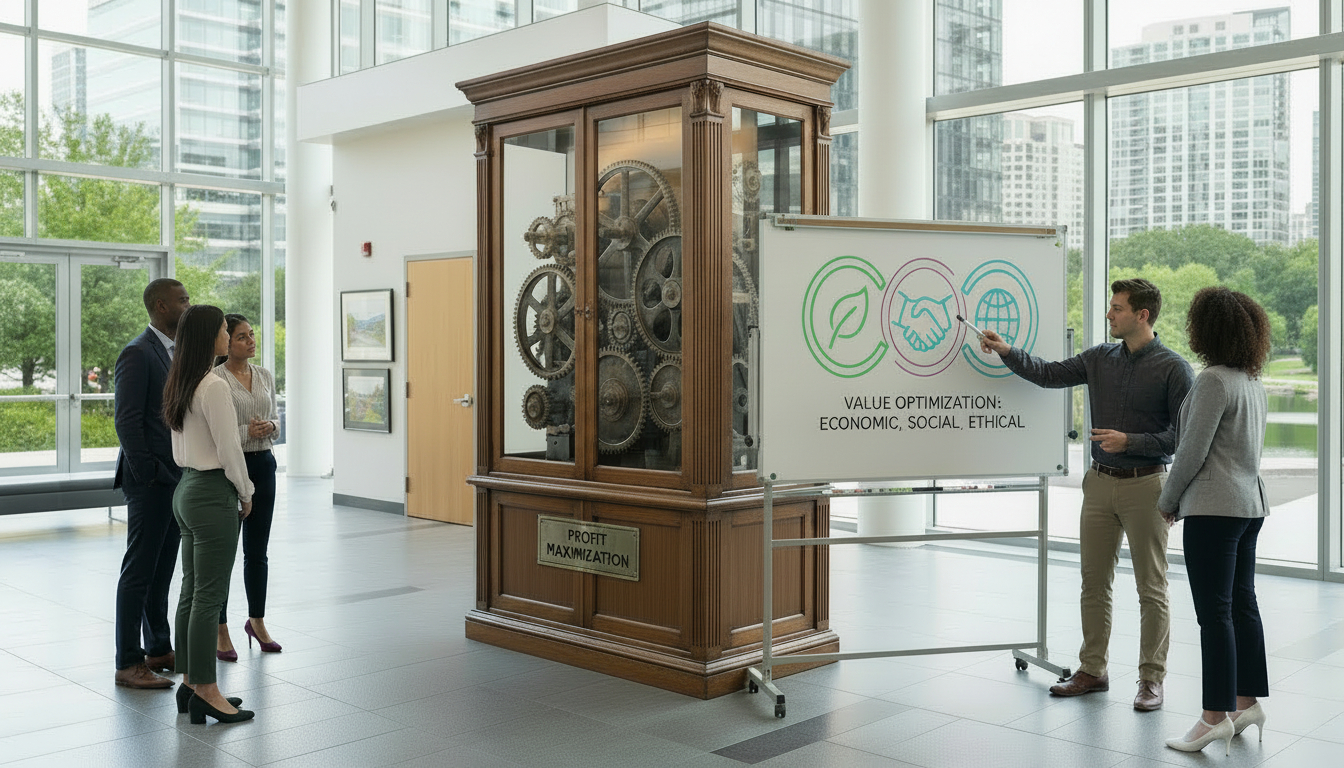
That is what a genuine organisational purpose is: not a statement of intent, but the objective the architecture is actually built to optimise.
The modern claim, and where it usually goes wrong
The case now made against Friedman is a case about purpose.
The organisation’s reason for existing, the argument goes, should no longer be maximising a single variable. It should be the optimisation of value across three dimensions at once:
Economic value: resilience and long-term viability, not only profit.
Social value: the wellbeing and potential of the people the organisation touches.
Ethical value: integrity and responsibility, even when inconvenient.
And this is correct. A purpose narrowed to one variable, in an environment as interconnected as the current one, optimises that variable at the expense of the conditions it depends on.
But nearly every contemporary version of this argument fails, and fails in the same way. It treats the new purpose as something you declare: a mission rewrite, a values framework, a reporting standard laid over the organisation.
A broader purpose declared over an architecture still built to optimise shareholder return changes nothing, because the architecture determines what the organisation optimises and the statement does not.
This is the lesson of every ESG program that produced glossy reports and unchanged behaviour. You cannot re-purpose an organisation by re-describing it. The fiduciary duty still runs one way. The incentives still point one way. The decision rights still sit where they always sat. Underneath the broader language, the machine is still optimising the single variable it was built for, and the machine wins.
That is the whole difference between a real change of purpose and a cosmetic one. Friedman’s purpose was real because the architecture expressed it. A multidimensional purpose becomes real on precisely the same terms: when the architecture is rebuilt to express it.
Why three values only works structurally
There is an objection that has to be met, because it exposes why this cannot be done any other way.
You cannot, a CFO will rightly say, optimise three variables at once. Optimisation needs a single objective, and the moment you set three targets, people meet whichever is easiest and trade off the rest.
That objection is correct, and it is fatal to the framework version of this argument, the one where economic, social and ethical value become three KPIs to hit. Three targets become three proxies to manage, and the purpose disappears behind the metrics.
The objection dissolves once the three stop being targets and become dimensions of a single conception of value, one the architecture is built to serve.
The organisation doesn’t chase three numbers. It is structured – in its ownership, its incentives, its consequence pathways – so that economic, social and ethical value are produced together, because the structure makes producing them together the rational path rather than a set of competing goals.
You don’t hit the three values. You build an architecture in which serving one doesn’t require betraying the others, and the combined value is then simply what the structure produces.
That isn’t a measurement problem. It is a design problem, solved in the wiring rather than on the scorecard.
What actually has to change
If purpose is the objective the architecture optimises, then changing the purpose means changing the architecture. Concretely, at the layers a mission statement never touches.
Ownership and governance structures that give the non-financial dimensions of value genuine standing rather than a mention in a report.
Executive incentives tied to the full conception of value, with real consequence attached, because an executive paid on one variable will serve that variable whatever the purpose statement says.
The fiduciary obligation itself, where the legal form allows it to be redefined, because as long as the binding duty runs only to shareholders, every other dimension of value is structurally a guest.
Consequence pathways are built so the responsible choice is the rational one, and economic, ethical, and social value are what the architecture produces by default rather than what someone has to fight incentives to protect.
None of these is a values statement. Each changes what the organisation is actually built to optimise.
The condition that decides whether it lasts
A further condition determines whether any of this holds.
Friedman’s architecture expressed something the organisation already believed. The structure and the conviction were the same thing, which is why it needed nobody to sustain it.
An architecture rebuilt for a purpose the organisation no longer holds is a different proposition. It works while someone insists on it and stops when they move on, which is the quiet fate of most purpose programs, and it gets recorded afterwards as a failure of commitment rather than as a mismatch anyone could have predicted.
So the question before the redesign is not whether the broader purpose is right. It is whether it is already what people here think matters, or whether it is being imposed on a culture that still answers the old way.
Beneath the architecture sits that foundation: the organisation’s real, operative answer to what pays off here. A change of purpose that doesn’t reach it is not a change of purpose. It is the old purpose in more acceptable language.
The point
Friedman was right about something his critics often miss: a purpose is only real when the structure is built to serve it. He was wrong only about which purpose, and the correction is not a broader statement of intent, but a broader objective built into the architecture itself.
The organisations that make this transition won’t be the ones with the most enlightened mission, the best-named framework or the most detailed sustainability report.
They will be the ones that did the structural work: rebuilding ownership, incentives, decision rights and consequence so that the architecture optimises for economic, social and ethical value together.
Because that work, and not a declaration, is what would make the new purpose as real as Friedman’s once was.
Everything short of it is window-washing on a machine still built to do what it always did.