
Culture Debt: The Hidden Liability
Culture Debt: The Hidden Liability Undermining Every Transformation
Organizations continue to try to transform on top of a broken operating system.
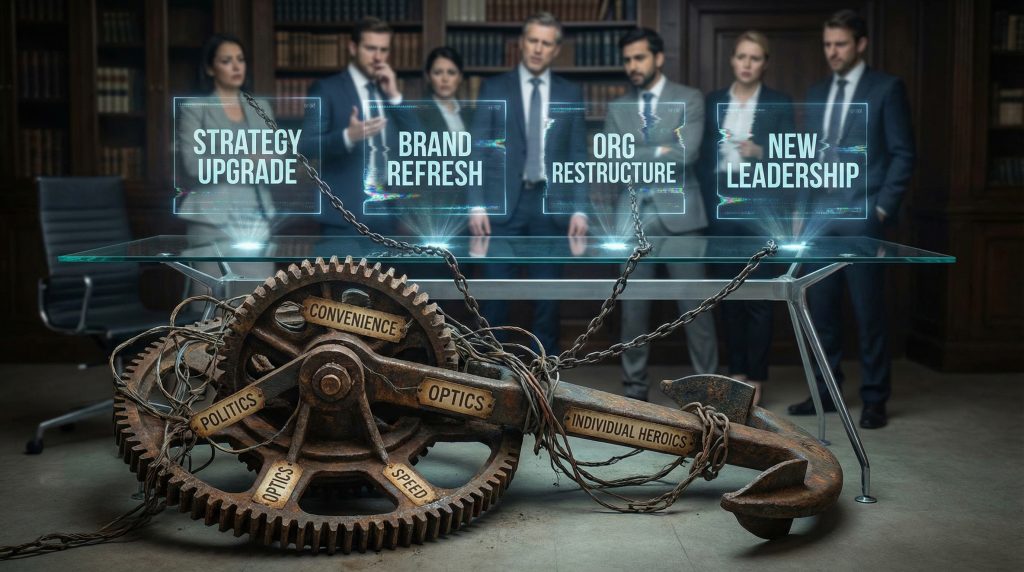
They upgrade the strategy, refresh the brand, restructure the organizational chart, and roll out new leadership models, all while running on cultural software last updated somewhere between the Industrial Revolution and the last charismatic CEO.
And then they wonder why nothing changes.
The truth is simple and uncomfortable:
Most transformations fail because the organization is culturally insolvent. They are drowning in culture debt, and pretending they’re not.
Culture Debt: The Liability Leaders Don’t Want to Admit
Culture debt is not about engagement, values, or employee experience. Those are partly symptoms, partly single elements of culture.
Culture Debt is the accumulated structural dysfunction created every time an organization chooses:
- convenience over courage
- politics over principle
- optics over truth
- speed over clarity
- individual heroics over collective capability
Every tolerated contradiction becomes a line item on the cultural balance sheet. Every unchallenged behavior becomes a hidden liability. Every leadership inconsistency becomes compound interest.
And like all debt, it grows silently until it becomes catastrophic.
Culture Is Not a Mood. It’s the Operating System.
Most leaders still view culture as an emotional climate, something to be improved, enhanced, or boosted. This is why they fail.
Culture is not a vibe. Culture is not a feeling. Culture is not a story you tell.
Culture is the structure, the operating system, that determines how decisions are made, how power flows, how conflict is handled, and how performance actually happens.
If the operating system is corrupted, no strategy will run properly.
You can’t install a transformation on top of malware.
Culture Debt Corrupts Performance
Culture debt doesn’t just undermine transformation; it distorts performance itself.
- It rewards visibility over value.
- It protects the politically skilled over the technically capable.
- It promotes the agreeable over the accountable.
- It punishes truth‑telling and rewards compliance.
This is why organizations misidentify high performers so consistently.
They’re not high performers; they’re high adapters to a flawed operating system.
Culture Debt creates a world where the wrong people win.
The Illusion of Cultural Fresh Starts
Leaders love the fantasy of cultural reinvention:
- new values
- new behaviors
- new leadership frameworks
- new engagement campaigns
- new slogans
But you cannot launch a new culture any more than you can launch a new personality.
Culture is not declared. Culture is carefully designed and managed.
The actual culture is the consequence of persistent and consistent reinforcement
If the operating system stays the same, the transformation is cosmetic.
Where Culture Debt Comes From (and Why Leaders Avoid It)
Culture debt accumulates through the everyday cowardice of leadership:
- The executive who demands accountability but avoids conversations.
- The manager who protects a toxic high performer because we need their numbers.
- The leadership team that preaches collaboration but rewards internal competition.
- The CEO who talks about trust but centralizes every decision.
These are not cultural glitches. This is cultural architecture.
And architecture always wins.
Paying Down Culture Debt: The Work Leaders Resist Most
Paying down culture debt requires structural honesty, not slogans.
1. Expose the real operating system.
Not the values on the wall. The values in the room.
2. Identify the tolerated behaviors that contradict the proclaimed culture.
These are the true indicators of Culture Debt.
4. Examine your existing direction and hallmarks, and what values would
be supportive.
If any one of these is nonsensical, not aligned, or not shared, nothing
will change, no matter what.
3. Remove the contradictions.
If you reward speed, stop punishing mistakes.
If you value accountability, stop protecting favorites.
If you want collaboration, stop incentivizing competition.
4. Identify contradicting behavior of leaders
Culture follows action, not posters.
5. Align systems with the culture you claim to want.
Performance management, decision rights, talent processes,
and leadership routines must reinforce the operating system,
not contradict it.
This is the repayment plan. It is not glamorous, but it is transformative.
The Real Competitive Advantage
Most organizations are running on outdated cultural software patched together with slogans, workshops, and wishful thinking. They are technically advanced but culturally rudimentary.
The few that confront their Culture Debt, honestly, structurally, and relentlessly, gain an advantage that cannot be copied:
a clean operating system.
Because strategy can be replicated. Technology can be purchased. Processes can be benchmarked.
However, a coherent, trusted, and high-integrity operating system (culture) is unstealable.
Culture Debt is the hidden liability undermining transformation.
Paying it down is the hidden advantage that enables it.