
The Great Competition Myth
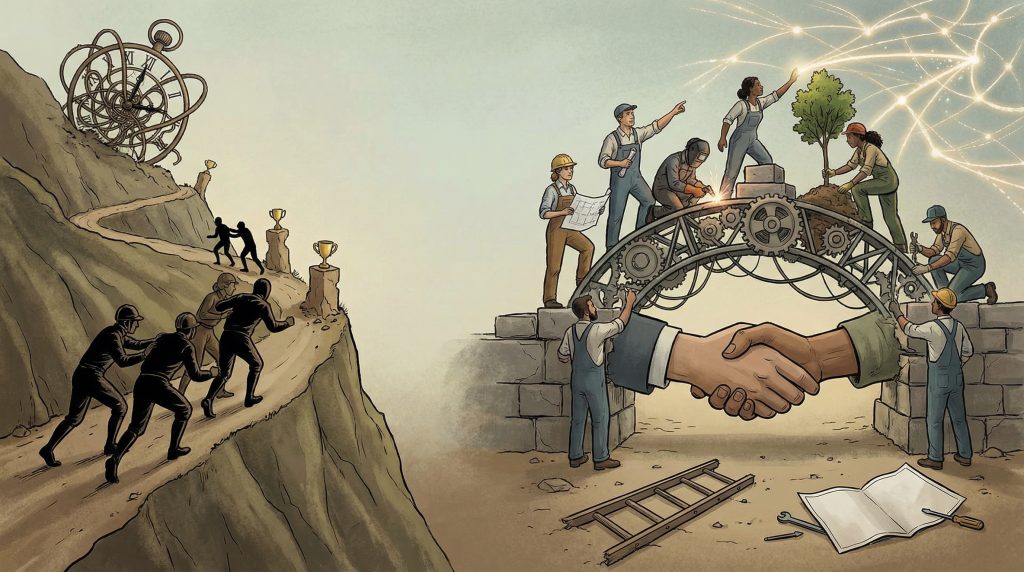
Why Your Organisation Competes With Itself
And why that’s a design choice, not a mindset problem
From the first graded test to the first performance review, we are taught that competition is the engine of progress: to get ahead, you outperform the person beside you. Most organisations are built on that belief. They rank, they grade on a curve, they reward relative standing. And then they are puzzled when their people hoard information, hide mistakes, and optimise for looking better than their colleagues rather than for the result the organisation actually needs.
That behaviour isn’t something a values campaign can reach. It is a structural output. People compete with each other because the architecture pays them to, and they will keep competing, no matter how often leadership preaches teamwork, because they are reading the incentives correctly.
Competition and collaboration are behaviours, not mindsets
The common framing treats these as character traits: some people are competitive, some collaborative, and the job is to cultivate the better attitude. That framing is why so much effort fails.
Put a naturally collaborative person on individual commission against their teammates and watch them start guarding their pipeline. Put a fierce competitor in a structure where the only reward is the team’s collective outcome and watch them start coaching the people around them. Neither had a change of heart. The architecture changed what behaviour paid off, and the behaviour followed.
So the question is never “how do we make our people more collaborative?”
It is “what is our structure actually rewarding?” And in a surprising number of organisations, the honest answer is zero-sum behaviour, installed by accident.
How organisations manufacture the destructive kind
Three structural choices reliably produce internal competition, and each carries a hidden cost.
The first is forced ranking. Stack ranking, curves, and “top performer” designations that are relative by construction. When standing is relative, the rational move isn’t to do excellent work; it is to be marginally better than the person next to you, which caps ambition at incrementalism. Why attempt the breakthrough that might fail when you only need to clear the colleague beside you? The structure rewards beating a rival, so people optimise for the rival rather than the problem.
The second is the secrecy tax. When pay, promotion or status depends on relative standing, sharing what you know becomes a cost. Mistakes go unnoticed because admitting them lowers your rank. People guard hard-won knowledge because sharing it helps a competitor. The organisation pays for the same errors again and again, because the architecture made honesty about failure personally expensive, so nobody’s failure ever teaches anyone else anything.
The third is severing individual accountability from collective outcome. When a person’s reward is tied purely to their own number and disconnected from whether the whole effort succeeded, collaboration becomes a tax on personal reward: time spent helping a colleague is time not spent on your own metric. The structure has made the cooperative act irrational, and then leadership wonders why people won’t cooperate.
Why this is the expensive choice
None of this argues that competition is bad and collaboration virtuous – that would only swap one mindset slogan for another.
The point is narrower and harder. The error isn’t competition as such. It is imposing a contest on something that isn’t one.
Two colleagues in the same organisation are not in opposition. If the organisation succeeds, both of them do. A ranking system manufactures a rivalry that did not exist and could not have arisen on its own, and then everybody behaves as though it were real — because, once installed, it is.
The same mistake gets made outward, and it is worth being honest about that rather than assuming external competition is automatically the right direction. Knowledge is not finite. Two organisations working on the same problem are not in a zero-sum relationship with respect to the problem itself; they are in competition for whatever follows from solving it. Treating the shared part as a race duplicates effort, withholds from each side exactly what the other needs, and slows what they both want. That is why the serious work in genomics, in open-source software, in standards, in clinical research has so often happened through consortia rather than contests.
Competition is the right structure where the thing being competed for is genuinely scarce. A contract goes to one bidder. A market position is held by one firm. Those are real contests and structuring for them is sensible.
It is the wrong structure everywhere else, and most of what matters in solving problems is not scarce at all.
Which is what makes internal zero-sum competition so expensive. Complex problems require different perspectives in genuine contact with one another, and an architecture that makes people guard their thinking starves itself of exactly the friction that produces breakthroughs. Progress depends on errors becoming shared knowledge, and an architecture that makes failure career-lowering guarantees they stay private and get repeated. An organisation built to make its people compete with each other is taxing its own intelligence and calling it performance management.
The accountability question, answered structurally
The usual objection is that collaboration dissolves individual accountability: if everyone shares, who is responsible?
That gets the architecture backwards. In a relative-ranking system, accountability is easy to dodge: hide the mistake, shift the blame, protect your standing. The structure itself rewards evasion.
In a system where reward is tied to collective outcome, and individual contribution is visible within it, accountability sharpens rather than dissolves. Think of a surgical team, or an orchestra: every individual has to perform at the height of their personal mastery, and there is nowhere to hide, precisely because the collective result depends on each visible part.
That is not the absence of individual excellence. It is individual excellence made structurally legible, with the incentive pointed at the shared outcome rather than at outscoring the person next to you. Collaboration done well doesn’t erase the individual; it gives individual mastery a structure in which it compounds instead of cancelling out.
The redesign
So the move isn’t a campaign telling people to be less competitive and more collaborative. That is exhortation against the grain of the incentive, and it fails the way all such campaigns fail.
The move is to look at what the architecture rewards, and to ask three questions:
Does standing depend on beating colleagues, or on meeting the problem?
Does sharing a mistake cost the person who shares it, or does the system make failure a source of collective learning?
Is individual reward severed from collective outcome, or connected to it?
Change those and the behaviour follows. Leave them, and no amount of values-talk will produce collaboration, because you will be asking people to act against what your own structure pays them to do.
The person who wins the internal race is still only outrunning a colleague. The organisation that stops staging that race, and points the effort at something genuinely worth competing over – or stops competing where nothing is actually scarce – is the one that moves.